South Korea has rapidly become one of the top study destinations for Bangladeshi students due to its affordable tuition fees, global ranking universities, scholarship opportunities, and strong job market. At StudyMax Global, we provide end-to-end consultancy support for students—from choosing the right university to visa processing and post-arrival guidance. Below you will find Step by Step guide for Study in South Korea from Bangladesh!
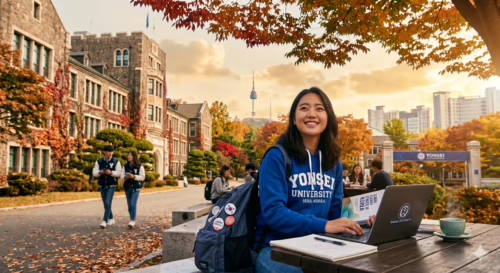
Students across Dhaka, Chittagong, Sylhet, Khulna, and all over Bangladesh are choosing South Korea for higher education because of several strong advantages.
South Korea offers high-quality education at a comparatively lower cost than countries like the USA, UK, Canada, or Australia. This makes it one of the most budget-friendly developed countries for international students.
Another major reason is that many universities allow students to study in Korea without IELTS, especially if they enroll in Korean language programs or meet alternative English requirements.
The South Korea student visa success rate from Bangladesh is relatively high, provided that documents are properly prepared and financial proof is strong.
Students can also work part-time, which helps reduce living expenses. Along with that, Korea is home to global companies like Samsung, Hyundai, LG, giving students access to strong career opportunities after graduation.
Study at globally recognized universities known for academic excellence and innovation. From QS Rank 38 to 1200 World Rank Universities!
Choose from a wide range of industry-focused programs designed for global careers. STEM, Industry ready subjects!
Experience a vibrant blend of tradition, technology, and international community.
Enjoy a high-quality lifestyle at a cost that is manageable for students.
Visa Types
• D-4 Visa → Language Course
• D-2 Visa → Degree Programs
• Processing Time: 4–8 weeks
• High success rate with proper documentation
Many students search: “Fully funded scholarship South Korea”
Major Scholarships:
Global Korea Scholarship (GKS):
University Scholarships:
Merit-Based Scholarships:
Scholarships significantly reduce the financial burden for Bangladeshi students.
One of the most searched topics is “How much does it cost to study in South Korea from Bangladesh?”
Estimated Cost
Total monthly cost: BDT 40,000–80,000
Compared to Western countries, South Korea offers high-quality education at a much lower cost.
South Korea has approximately 400+ universities and higher education institutions, including national, public, and private universities.
Location-wise Universities
Seoul (Capital – Top Ranked)
Busan
Daegu
Daejeon
Gwangju
Other Regions
Engineering & Technology
Business & Management
IT & Artificial Intelligence
Medical & Life Sciences
These universities are popular among Bangladeshi students due to lower tuition fees and flexible admission criteria.
Students can apply for multiple study options:
To apply from Bangladesh, students need:
Language Requirements
A Korea E-Visa (Electronic Visa) is a digitally issued visa approved online by Korean Immigration.
Key Features:
Most universities now issue eVisa confirmation for students, making the process quicker and easier.
A Regional Visa is a special visa program designed to encourage international students to study in less populated cities outside Seoul.
Benefits:
This is highly beneficial for Bangladeshi students looking for affordable study options in Korea.
Document attestation is a critical step for Korea student visa.
Step-by-Step Process:
Without proper attestation, your visa application may be rejected.
Students can work:
Jobs include restaurants, factories, retail, and campus work.
Adapting to Korean culture may take time, especially language, but overall the lifestyle is highly rewarding.Students also enjoy access to technology, global networking, and career growth opportunities.
StudyMax Global supports students from:
• Expert student counselors
• High visa success rate
• Complete admission & visa support
• Scholarship guidance
• Pre-departure briefing
If you are serious about studying in South Korea from Bangladesh, this is one of the best opportunities right now due to:
With expert support from StudyMax Global, your journey becomes easy, fast, and successful.
To study in South Korea from Bangladesh, you need to choose a university, apply for admission, receive an offer letter, prepare financial documents, and apply for a student visa (D-2 or D-4).
Yes, South Korea is a great destination due to affordable tuition fees, globally ranked universities, scholarships, and part-time work opportunities.
Yes, many universities allow students to study in South Korea without IELTS if they meet other requirements or enroll in Korean language programs.
Benefits include low cost, high-quality education, scholarship opportunities, part-time jobs, and global career exposure.
You need an I-20 form from an accepted SEVP-approved university, complete the DS-160 form, pay the SEVIS fee, and schedule a visa interview at the U.S. Embassy in Dhaka.
How much does it cost to study in South Korea from Bangladesh?
The total cost ranges from BDT 6–12 lakh per year including tuition and living expenses.
Living costs range between BDT 40,000–80,000 per month depending on lifestyle and location.
Yes, studying in South Korea is significantly cheaper than the UK, USA, or Australia.
Usually, a bank statement of USD 10,000–20,000 (or equivalent in BDT) is required.
Yes, you can study for free if you receive a fully funded scholarship like the Global Korea Scholarship.
Popular options include government scholarships, university scholarships, and merit-based funding.
You need strong academic results, a good SOP, and proper documentation to apply successfully.
It is competitive but achievable with good academic performance and proper guidance.
It is a fully funded government scholarship covering tuition, living expenses, and airfare.
Yes, many universities offer partial scholarships even for average students
You need academic certificates, passport, SOP, bank statement, and sometimes IELTS or TOPIK.
Generally, a GPA of 2.5–3.0+ is acceptable depending on the university.
Not always. Many universities accept students without IELTS.
TOPIK is the Korean language proficiency test required for Korean-taught programs.
Yes, many students start with a Korean language course (D-4 visa).
You need an offer letter, financial proof, and required documents to apply.
It usually takes 4–8 weeks.
D-2 (degree programs) and D-4 (language programs).
The success rate is high if documents are properly prepared.
Common reasons include weak financial proof, incomplete documents, and poor SOP.
Yes, students can work up to 20 hours per week.
Students can earn enough to cover part of their living expenses.
Yes, part-time jobs are widely available.
Basic Korean language skills are helpful.
Yes, students can work full-time during vacation periods.
Yes, you can apply for a work visa after completing your studies.
Yes, long-term work can lead to permanent residency.
Yes, especially in IT, engineering, and business sectors.
It depends on your skills, qualification, and language proficiency.
Yes, it offers strong career opportunities in global industries.
Yes, students from Dhaka can easily apply through consultancy or directly.
StudyMax Global is one of the trusted consultancies with high visa success.
Admission processing takes around 2–6 weeks.
Usually no, but it depends on the embassy requirements.
Yes, you can apply for undergraduate programs or language courses.
March and September are the main intakes.
Generally, it is difficult for undergraduate students but possible for Masters program.
Yes, South Korea is one of the safest countries.
It has four seasons including cold winters and warm summers.
Yes, transfer is possible under certain conditions.
There are mainly two intakes: Spring and Fall.
Yes, depending on university policies.
Yes, it is mandatory for international students.
Offer letter, bank statement, passport, academic documents, and application form.
StudyMax Global provides complete support including admission, visa processing, and pre-departure guidance.

StudyMax Global is more than just a consultancy firm; we are a partner in our students’ success.
Our commitment to providing personalized, expert guidance, combined with our global network and comprehensive support services, makes us the ideal choice for students aspiring to study abroad.
We are dedicated to helping students navigate the complexities of the application process and achieve their academic and professional goals on an international stage.
© 2024 - StudyMax Global | All Rights Reserved.